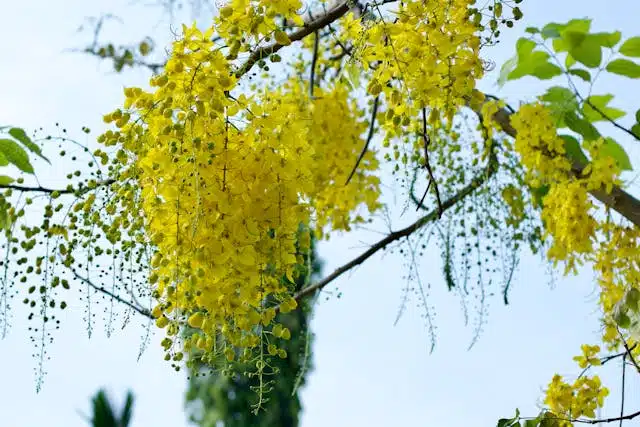
Every summer, certain trees suddenly explode into bright yellow blooms and turn entire streets into golden corridors. The first time we notice the Golden Shower Tree in full bloom, it is easy to mistake it for a Copper Pod Tree.
That confusion is very common because both trees flower around the same season and both carry striking yellow blossoms. But once we look closely, we realise they are very different in shape, structure, and flowering style.
In this guide, we will explore everything about the Golden Shower Tree, including its history, meaning, identification, flowering season, growing conditions, and interesting facts that make it one of the most loved ornamental trees in tropical regions.
What Is a Golden Shower Tree?
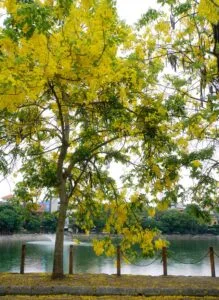
The Golden Shower Tree, scientifically known as Cassia fistula, is a medium sized deciduous tree known for its long cascading clusters of bright yellow flowers. It belongs to the legume family and is native to the Indian subcontinent and Southeast Asia.
It is widely known by different names such as:
- Golden Shower Tree
- Indian Laburnum
- Amaltas
The name reflects its most striking feature, the way flowers hang in long drooping clusters like a shower of gold.
History of the Golden Shower Tree
The Golden Shower Tree has been part of South Asian landscapes for centuries. It is commonly found in temple gardens, palace courtyards, village roads, and public parks. Its presence in traditional spaces shows how deeply it is connected with cultural and seasonal cycles.
In India, the tree has long been associated with the arrival of summer. Old traditions often link its blooming period with seasonal change and natural renewal. Over time, its ornamental value made it popular beyond its native region, and it is now grown in many tropical countries across Asia, Africa, and other warm regions.
Etymology: Why It Is Called Golden Shower Tree
The name comes directly from its appearance during blooming. When the tree flowers fully, thousands of yellow blossoms hang in long chains from the branches. From a distance, this looks like golden rain falling from the canopy, which led to the name Golden Shower Tree.
The scientific name Cassia fistula also has meaning. “Cassia” is an old botanical term used for related flowering plants, while “fistula” refers to tube like structures, pointing to the long cylindrical seed pods produced by the tree.
In India, it is more commonly known as Amaltas, a name that is widely used in everyday language and gardening conversations.
Where Is the Golden Shower Tree Found?
The Golden Shower Tree is native to:
- India
- Sri Lanka
- Myanmar
- Thailand
- Parts of Southeast Asia
Today, it is also naturalised in many tropical and subtropical regions around the world, including parts of Africa, Australia, and the Americas. It thrives in warm climates where winters are mild and summers are long.
About Golden Shower Tree
| Feature | Details |
|---|---|
| Scientific name | Cassia fistula |
| Common names | Amaltas, Indian Laburnum |
| Tree type | Deciduous |
| Height | 10–20 meters |
| Flower colour | Bright yellow |
| Blooming season | April to June |
| Native region | South and Southeast Asia |
How to Identify a Golden Shower Tree
Flowers
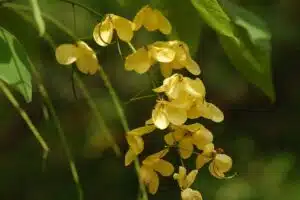
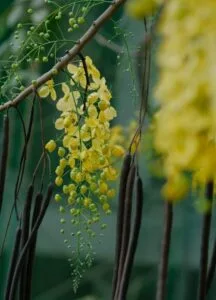
The most striking feature is the long hanging flower clusters. Each cluster can carry dozens of small yellow flowers arranged in a cascading pattern.
Leaves
Leaves are compound and arranged neatly along a central stem. Young leaves often appear slightly reddish before turning green.
Seed Pods
After flowering, long cylindrical seed pods develop. These pods are dark brown and can remain on the tree for months.
Bark
The bark is greyish brown and becomes rougher with age.
Golden Shower Tree Flowering Season
In most parts of India, the Golden Shower Tree blooms between April and June. This period often coincides with the peak of summer. The tree may shed part of its leaves before flowering, which makes the yellow blooms stand out even more.
The combination of heat, dry conditions, and full sunlight helps trigger heavy flowering, making the tree one of the most visually striking summer bloomers.
Why Does the Golden Shower Tree Bloom So Beautifully?
The tree produces flowers in abundance to attract pollinators during the dry season. Since fewer plants bloom at this time, insects like bees and butterflies are drawn strongly to its bright yellow flowers.
This natural strategy increases pollination success and creates the dramatic golden display that the tree is famous for.
Golden Shower Tree vs Copper Pod Tree
This is one of the most common confusions among readers.
Golden Shower Tree
- Long drooping flower clusters
- Flowers hang like golden chains
- Peak bloom before monsoon
- Distinct cylindrical seed pods
Copper Pod Tree
- Flowers appear in denser clusters
- Canopy is broader and umbrella shaped
- Seed pods are flatter and different in texture
- Slightly different flowering pattern
A quick look at the flower arrangement usually helps us identify them correctly.
How to Grow a Golden Shower Tree
Sunlight
The tree grows best in full sunlight. At least 6 to 8 hours of direct sun is important for healthy flowering.
Soil
It adapts to many soil types including sandy and loamy soil. Good drainage is essential.
Watering
Young trees need regular watering. Mature trees become drought tolerant and require less frequent watering.
Fertilizer
Organic compost once or twice a year is usually enough. Excess nitrogen can reduce flowering.
Space
The tree needs enough space to grow freely since it becomes large at maturity.
Care Tips
Regular pruning helps maintain shape and remove weak branches. Mulching around the base helps retain soil moisture. The tree is generally hardy and does not require intensive maintenance once established.
Can It Grow in Pots?
It can be grown in large containers only in the early stage. However, it is not suitable for long term pot cultivation because it develops a deep and wide root system.
Uses of Golden Shower Tree
Ornamental Value
It is widely planted in parks, gardens, and roadsides for its stunning floral display.
Shade Tree
The canopy provides good shade during hot summers.
Avenue Tree
Many cities use it for roadside plantations because of its visual impact during flowering season.
Wildlife Importance
The flowers attract bees, butterflies, and other pollinators. This makes the tree valuable for supporting local biodiversity in urban and rural ecosystems.
Interesting Facts
- It is the national tree of Thailand
- It is known as Amaltas in India
- Flowers often appear before full leaf growth
- Seed pods can remain on the tree for long periods
- It is one of the most photographed summer flowering trees
Common Problems
Poor flowering
Usually caused by low sunlight or excess fertilizer.
Yellow leaves
Often linked to drainage issues or nutrient imbalance.
Slow growth
Normal in early years as the tree establishes roots.
Frequently Asked Questions
How fast does a Golden Shower Tree grow?
The tree grows at a moderate rate and usually takes a few years to establish strong roots before it begins heavy flowering. Once settled, growth becomes steady and more predictable.
How long does it bloom each year?
The flowering period usually lasts several weeks during late spring and early summer. In ideal conditions, the display may continue for a longer duration depending on climate and rainfall.
Is it suitable for small gardens?
It is generally not ideal for small gardens because it becomes a large tree at maturity. We recommend planting it in open spaces where it has enough room to grow naturally.
Does it require a lot of maintenance?
No, it is relatively low maintenance once established. Occasional pruning, basic watering, and sunlight are usually enough to keep it healthy.
Can it survive dry conditions?
Yes, mature trees can handle dry periods quite well. Young plants still need regular watering until they are fully established in the soil.
Conclusion
The Golden Shower Tree is one of the most striking flowering trees found in tropical regions. Its cascading yellow blooms, seasonal beauty, and cultural presence make it a favourite in landscapes across India and beyond.
Whether we see it as Amaltas, Indian Laburnum, or Golden Shower Tree, its golden display every summer continues to leave a lasting impression.