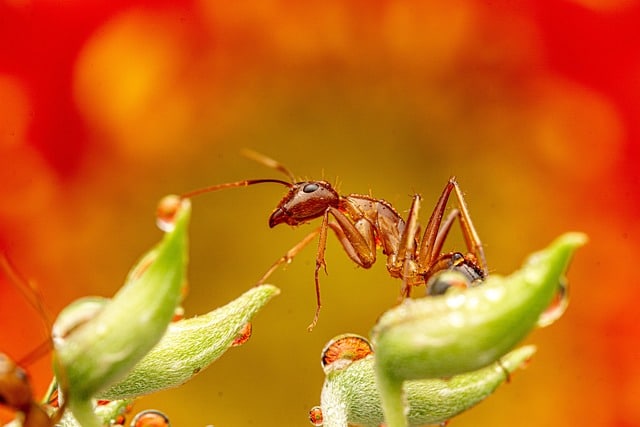
One afternoon while looking at a mango tree in our office, we noticed something unusual. Several leaves were folded together as if someone had stitched them by hand. When we looked closer, it was not damage or disease. It was a living structure made by ants working together with perfect coordination.
That moment changes how we see a simple mango tree. It is no longer just a fruit-bearing plant. It becomes a home, a hunting ground and an entire ecosystem built by some of nature’s most organized insects.
Introduction: A Living City in a Tree
Weaver ants are among the most fascinating insects found in tropical regions. They do not live underground like most ants. Instead, they build their homes on trees using living leaves.
Their nests are not random shelters. They are carefully constructed structures made through teamwork, planning and continuous coordination.
Mango trees are one of their most common habitats, especially in India and other tropical regions.
What Are Weaver Ants?
Weaver ants are social insects known for building leaf nests by stitching leaves together.
Oecophylla smaragdina is the most common species in India and Southeast Asia. Another species exists in Africa.
Oecophylla longinoda is found across tropical African regions and shows similar nesting behavior.
Key Characteristics
- Highly social insects
- Live in large colonies
- Build nests in trees
- Use larvae to produce silk
- Extremely organized teamwork
Global Distribution: Where Weaver Ants Are Found
Weaver ants are mainly found in tropical and subtropical regions where warm weather supports their survival.
Asian Region
India, Sri Lanka, Bangladesh, Myanmar, Thailand, Malaysia, Indonesia, southern China and northern Australia.
African Region
Tropical regions across central and western Africa.
Why Only These Regions
Their survival depends on:
- Warm temperatures
- Dense tree cover
- High humidity
- Continuous insect food supply
Even though they are separated by continents, both species evolved almost identical lifestyles.
Why Mango Trees Are Their Favorite Home
Mango trees provide everything a weaver ant colony needs.
Flexible Leaves for Construction
Young mango leaves bend easily, making them ideal for weaving nests.
Dense and Protective Canopy
The thick foliage protects colonies from rain, heat and predators.
Abundant Food Supply
Mango trees attract many insects that serve as food for the colony.
Long-Term Stability
A mango tree can support colonies for many years, sometimes decades.
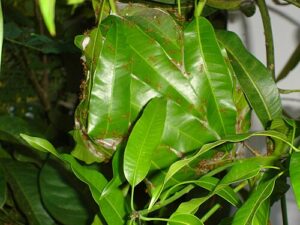
Although mango trees are among their most common nesting sites, weaver ants are not limited to them. They can also be found building nests on cashew, jamun, guava, citrus, litchi and many other broad-leaved trees.
In my own observations, their woven leaf nests are quite common on both cashew and jamun trees. What these trees have in common is a dense canopy, flexible young leaves and a steady supply of insects for food.
How Weaver Ants Build Their Nests
This is where their engineering ability becomes visible.
Step 1: Selecting the Right Leaves
Workers identify leaves that are close enough and flexible enough for construction.
Step 2: Pulling Leaves Together
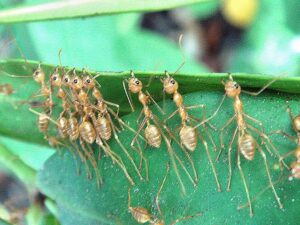
Ants work in groups to pull leaf edges closer using their bodies.
Step 3: Forming Living Chains
When distance is large, ants connect themselves into chains to extend reach and apply force.
Step 4: Using Larvae as Silk Tools
Worker ants carry larvae that produce silk. They move them along leaf edges like living stitching tools.
Step 5: Final Nest Formation
The silk binds leaves permanently, creating a secure living chamber.
Life Inside a Weaver Ant Colony
A colony is not a single nest but a network of nests.
Nest Roles
- Brood nests for eggs and larvae
- Worker nests for activity and storage
- Guard zones for protection
Communication System
Ants communicate using chemical signals that control movement, alert danger and coordinate work.
There is no single leader. The colony works as a self-organized system.
Weaver Ants and Mango Tree Health
Benefits
- Natural pest control
- Reduces harmful insects
- Lowers need for pesticides
Challenges
- Painful bites when disturbed
- Can protect sap-sucking insects
- Can make harvesting difficult
In most natural settings, their benefits outweigh the challenges.
Weaver Ants as Food and Cultural Resource
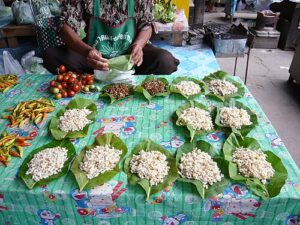
In several parts of the world, weaver ants are also used as food.
Their larvae, pupae and eggs are collected and eaten in regions of India, Southeast Asia and Africa.
They are valued because:
- High protein content
- Seasonal availability
- Traditional culinary use
- Distinct taste and texture
For many rural communities, they also contribute to seasonal income.
A Living Example of Cooperation
What makes weaver ants truly remarkable is not just what they build but how they build it.
No single ant can create a nest alone. Every task is divided and repeated across thousands of individuals.
See the pattern : Some build, some guard. Some feed larvae. Some repair damage.
Together they create something far larger than themselves.
Lessons From a Weaver Ants Life
Small Efforts Build Big Results
A nest is created through countless small actions repeated over time.
Cooperation Creates Strength
A single ant is weak alone but powerful in a group.
Shared Purpose Reduces Chaos
Thousands of ants move in harmony because they follow one goal.
Nature Works With What Exists
They do not search for perfect materials. They use what is already available.
Systems Work Better Than Individuals
The colony succeeds because it behaves like a system, not a collection of individuals.
Conclusion: What the Tree Teaches Us
A mango tree with weaver ant nests is more than a natural curiosity. It is a working example of cooperation and balance.
These ants show that intelligence is not always individual. Sometimes it is distributed across many small lives working together.
When we observe them closely, we see an entire system built on patience, coordination and shared effort.
In their quiet world among the leaves, we find a simple truth. The strongest creations are often built not alone but together.